Performance marketing is advertising where you pay for, and judge everything by, a measurable result: a click, a lead, a sale. If a campaign does not bring results you can count, you change it or stop it.
It is now where most Indian ad money goes. Digital took 59% of India's ₹1,21,339 crore ad market in 2025, about ₹71,621 crore, and is projected to reach 70% by 2027 (dentsu Digital Advertising Report 2026). Social media (29%) and paid search (23%) take the biggest shares of that digital spend.
This guide explains how performance marketing works, which numbers to track and how to plan your first 90 days. The examples use real figures from Meta ad accounts we manage for Indian brands, with client names removed.
What is performance marketing?
Performance marketing is any marketing where success is measured by an action people take, not by how many people saw the ad. You decide the action first (a lead form, a WhatsApp chat, a purchase), track it, and then spend more on whatever produces it at a cost you can afford.
It is also called performance-based marketing or performance-based advertising. The idea is the same: every rupee is tied to a result you can count.
How you pay
On most platforms you still pay for impressions or clicks. What changes is what you optimise for and how you judge the campaign.
|
Model |
You pay for |
Common on |
|
CPM (cost per 1,000 impressions) |
Your ad being shown |
Meta Ads, YouTube, display |
|
CPC (cost per click) |
A click to your site or app |
Google Search, Meta Ads |
|
CPL (cost per lead) |
A form fill, call or chat |
Lead campaigns, lead ads |
|
CPA (cost per acquisition) |
A sale, sign-up or install |
Affiliate deals, Smart Bidding targets |
Even when Meta bills you per impression, its delivery system tries to show your ad to people most likely to take the action you chose. Google's Smart Bidding works the same way: Target CPA aims for as many conversions as possible at the cost you set, and Target ROAS aims for as much revenue as possible at the return you set (Google Ads Help).
Performance marketing vs digital marketing
Performance marketing is one part of digital marketing. Digital marketing covers everything you do online; performance marketing is the part you judge by direct results.
|
|
Digital marketing |
Performance marketing |
|
Scope |
SEO, social media, content, email, ads, website |
Mainly paid ads tied to a tracked action |
|
Main goal |
Reach, trust and demand over time |
Leads and sales now |
|
How success is measured |
Reach, followers, rankings, engagement, plus results |
Cost per lead, cost per sale, ROAS |
|
Speed |
SEO and content take months |
Results within days of launch |
|
When spending stops |
Rankings and content keep working |
Results stop soon after |
You need both. Performance ads bring buyers today, while SEO, content and a strong brand make each of those ads cheaper over time, because people who already know you click and buy more readily.
How performance marketing works
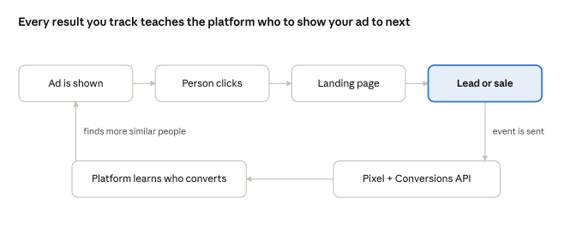
A performance campaign is a loop. The ad brings a visit, the visit becomes a lead or sale, and tracking sends that result back to the ad platform so it can find more people like the ones who converted.
How a performance campaign learns · 5 steps and a feedback loop
Three parts decide whether that loop works.
1. Tracking. On Meta, the Pixel records actions in the browser and the Conversions API sends the same events from your server. Meta says the server route can catch events the browser misses and is less affected by browser crashes, connection problems and cookie limits. When you send the same event both ways, give it the same event ID so Meta counts it once (Meta for Developers). On Google, conversion tracking and GA4 do the same job.
2. The learning phase. The delivery system needs enough results to learn from. Meta marks an ad set Learning limited when it is unlikely to get about 50 optimisation events in the week after its last significant edit, and suggests combining ad sets, widening the audience or raising the budget to fix it (Meta Business Help). This is why small budgets split across many ad sets rarely work.
3. Attribution. Each platform decides which ad gets credit for a sale. Meta reports conversions within windows such as 1-day click, 7-day click and 1-day view (Meta Business Help). Google Ads now offers only data-driven and last-click models, and data-driven is the default for most conversion actions (Google Ads Help). Because each platform counts its own way, always check platform numbers against real orders or leads in your CRM.
Performance marketing channels
Pick channels by where your buyer is when they are ready to act. Most Indian brands should start with one or two, not five.
|
Channel |
What it is good at |
Best for |
Watch out for |
|
Meta Ads (Facebook, Instagram) |
Creating demand: showing a product to people who were not searching for it |
D2C brands, local services, education, events |
Creative tires fast; needs fresh ads every few weeks |
|
Google Search Ads |
Capturing demand: people already searching for what you sell |
Services, B2B, high-intent products |
Costly keywords; needs tight keyword and negative lists |
|
Google Performance Max and Shopping |
Showing products across Google from one campaign |
E-commerce stores with a product feed |
Less control over where ads appear |
|
YouTube Ads |
Explaining a product with video, then retargeting viewers |
Products that need a demo |
Judge it on conversions, not views |
|
Affiliate and marketplace ads |
Paying partners or marketplaces per sale |
Brands selling on Amazon, Flipkart or through partners |
Margins after commission |
|
Influencer campaigns (tracked) |
Borrowing trust from a creator, measured with codes or links |
Fashion, beauty, food, apps |
Only performance if every sale is tracked |
A simple rule: use Google Search when people already know what they want, and Meta when you need to show them something they didn't know they needed.
Performance marketing KPIs
Track a few numbers well instead of every number in the dashboard. These are the key performance indicators that tell you whether ads are making money.
|
KPI |
Formula |
What it tells you |
|
CPM |
Spend ÷ impressions × 1,000 |
How expensive your audience is to reach |
|
CTR |
Clicks ÷ impressions |
Whether the ad stops the scroll |
|
CPC |
Spend ÷ clicks |
What each visit costs |
|
Conversion rate |
Leads or orders ÷ visits |
Whether the landing page convinces |
|
CPL |
Spend ÷ leads |
What each enquiry costs |
|
CPA |
Spend ÷ sales |
What each customer costs |
|
ROAS |
Revenue from ads ÷ ad spend |
Revenue per rupee of ads |
|
CAC |
All marketing and sales cost ÷ new customers |
True cost of a customer, beyond ads |
|
LTV |
Average order value × orders per customer × gross margin |
What a customer is worth over time |
Find your break-even ROAS first
A "good" ROAS depends on your margin, not on an industry average. Break-even ROAS is 1 divided by your gross margin. If you keep 40% of each sale after product cost, shipping and returns, you need a ROAS of 2.5 just to cover ads (1 ÷ 0.40). Anything above that is profit.
What we see in Indian Meta accounts
In 2025 study of 1,280 US Facebook campaigns, traffic campaigns had a median click-through rate of 1.71% and a cost per click of $0.70, while lead campaigns reached 2.59% CTR, a 7.72% conversion rate and a $27.66 cost per lead, up 21% on the year before. India is one of the cheapest markets to reach people on Meta: Superads puts the median CPM at about $1.35 and the median CPC at about $0.10 across the accounts in its dataset, and Lebesgue’s 2026 e-commerce data ranks India lowest of 50 countries at $1.36 CPM. Treat these as reference points, not targets: cheap reach does not guarantee cheap customers, and your niche, city and season can move every number.
Performance marketing strategy: a 90-day plan
The order matters more than the tactics. Most wasted ad budgets we audit skipped the first phase and went straight to spending.
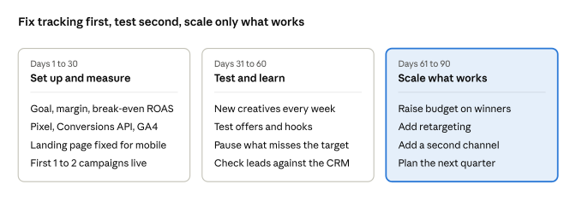
A 90-day performance marketing plan · 3 phases
Days 1 to 30: set up and measure. Write down one goal (leads or sales), your gross margin and your break-even ROAS or maximum cost per lead. Install the Meta Pixel with the Conversions API and Google conversion tracking, then test that every lead and order is recorded. Fix the landing page for mobile before you spend. Launch one or two campaigns with a budget large enough to get results each week.
Days 31 to 60: test and learn. Creative is the biggest lever on Meta, so test new ad angles, hooks and offers every week. Keep ad sets few and broad so each one gets enough results to exit the learning phase. Pause ads that stay above your target cost after a fair test. Match platform leads against your CRM or WhatsApp to see which campaigns bring real buyers.
Days 61 to 90: scale what works. Raise budgets on campaigns that stay under your target cost, in steps, and watch whether the cost holds. Add retargeting for people who visited but did not buy. Once one channel is profitable, test a second one, such as Google Search next to Meta.
Performance marketing examples from real Indian accounts
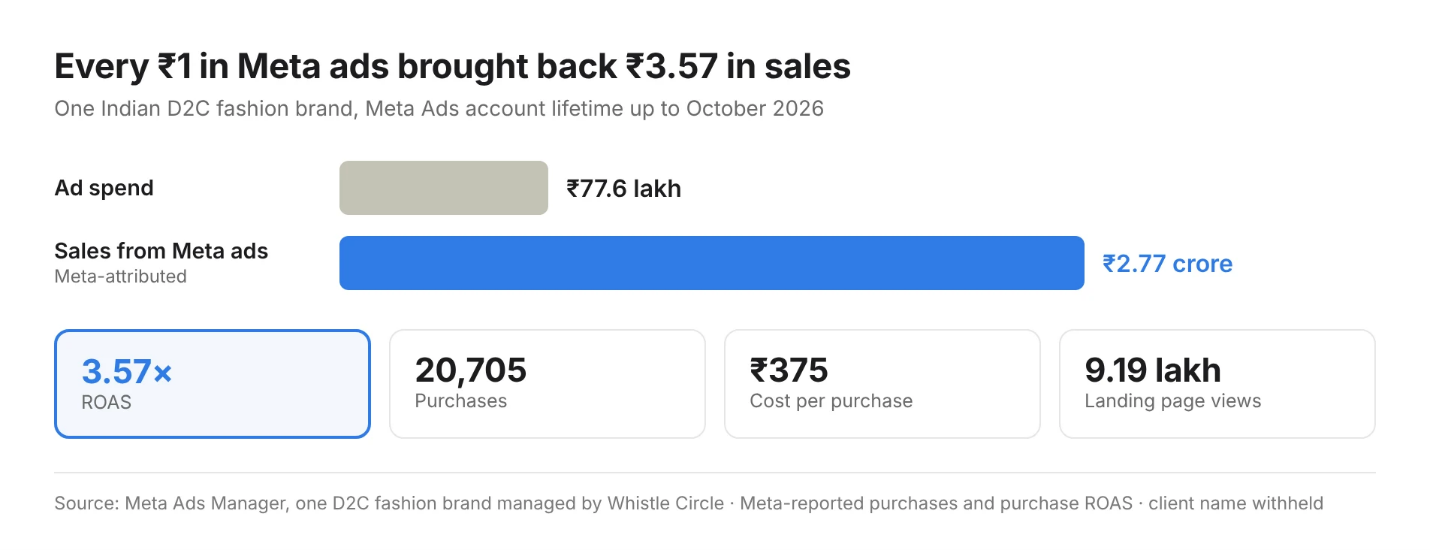
These are Meta Ads accounts we manage. Figures are Meta-reported, cover each account's lifetime up to October 2026, and client names are removed.
|
Business |
Goal |
Ad spend |
Results |
Cost per result |
|
D2C fashion brand |
Online sales |
₹77.6 lakh |
20,705 purchases, ROAS 3.57 |
₹375 per purchase |
What these numbers teach.
• ROAS is what pays the bills. The fashion brand's 3.57 ROAS means about ₹2.77 crore in Meta-attributed sales from ₹77.6 lakh in ads. Its funnel also shows where buyers drop: only 8.3% of 9,18,930 landing page views added to cart, while 45% of people who started checkout paid. We wrote up the fixes in Why 92% of Shopify visitors don't add to cart.
Common performance marketing mistakes
These are the mistakes we see most often when we audit Indian ad accounts.
1. Spending before tracking works. If leads and orders are not recorded correctly, the platform optimises for the wrong people and your reports cannot be trusted.
2. Splitting a small budget into many ad sets. Each ad set then gets too few results to leave the learning phase. Fewer, broader ad sets usually do better.
3. Judging by cost per lead alone. Cheap leads that never answer the phone cost more than expensive leads that buy. Track cost per customer.
4. Sending ads to a weak page. A slow page, missing sizing, unclear delivery dates or no COD option loses buyers the ad already paid for. See our Shopify conversion rate optimization guide.
5. Running the same creative for months. Results fade as the same people see the same ad. Plan new creatives every week or two.
6. Trusting platform numbers blindly. Meta and Google each count conversions their own way. Compare them with real orders and CRM leads every month.
7. Hiring the wrong partner. Watch for vague reports, guaranteed results and agencies that keep your ad accounts in their name. Our list of digital marketing agency red flags covers what to check.
When to hire a performance marketing agency
You can run your own ads when the budget is small and you have time to learn. An agency or specialist makes sense when:
• you spend enough each month that a 20% better cost per result pays for the help;
• tracking, creative testing and reporting are taking time away from running the business;
• results have stalled and you cannot tell whether the problem is the ads, the page or the offer.
Before you hire, ask how they will measure success, who owns the ad accounts and how often you will get a report you can check against your own sales.
If you want a second opinion first, our performance marketing team in Delhi can review your ads and tracking. Get a free plan with the numbers we would target for your budget.
Performance marketing FAQs
What is performance marketing in simple words? Advertising where you track a specific result, like a lead or a sale, and spend more only on what produces it at a cost you can afford.
Is performance marketing the same as digital marketing? No. It is the part of digital marketing judged by direct results. SEO, content and social media building a brand are digital marketing too, but they are measured over a longer time.
How much budget do I need to start? Enough to get regular results each week. On Meta, an ad set is marked Learning limited when it is unlikely to get about 50 optimisation events a week, so work backwards from your expected cost per result and keep the number of ad sets small.
What is a good ROAS? Any ROAS above your break-even point, which is 1 divided by your gross margin. A brand with a 40% margin breaks even at a ROAS of 2.5.
How long does performance marketing take to show results? Ads start delivering within days, but plan on about 90 days to set up tracking, test creatives and find campaigns worth scaling.
Which is better for Indian businesses, Meta Ads or Google Ads? Google Search works best when people already search for what you sell. Meta works best when you need to show people a product they were not looking for. Many brands use both.
How we put this together. Account figures come from Meta Ads Manager for the accounts named in the examples, covering each account's lifetime up to October 2026, as reported by Meta. Client names are withheld. Market figures and platform rules come from the sources below.
 LinkedIn
 WhatsApp